

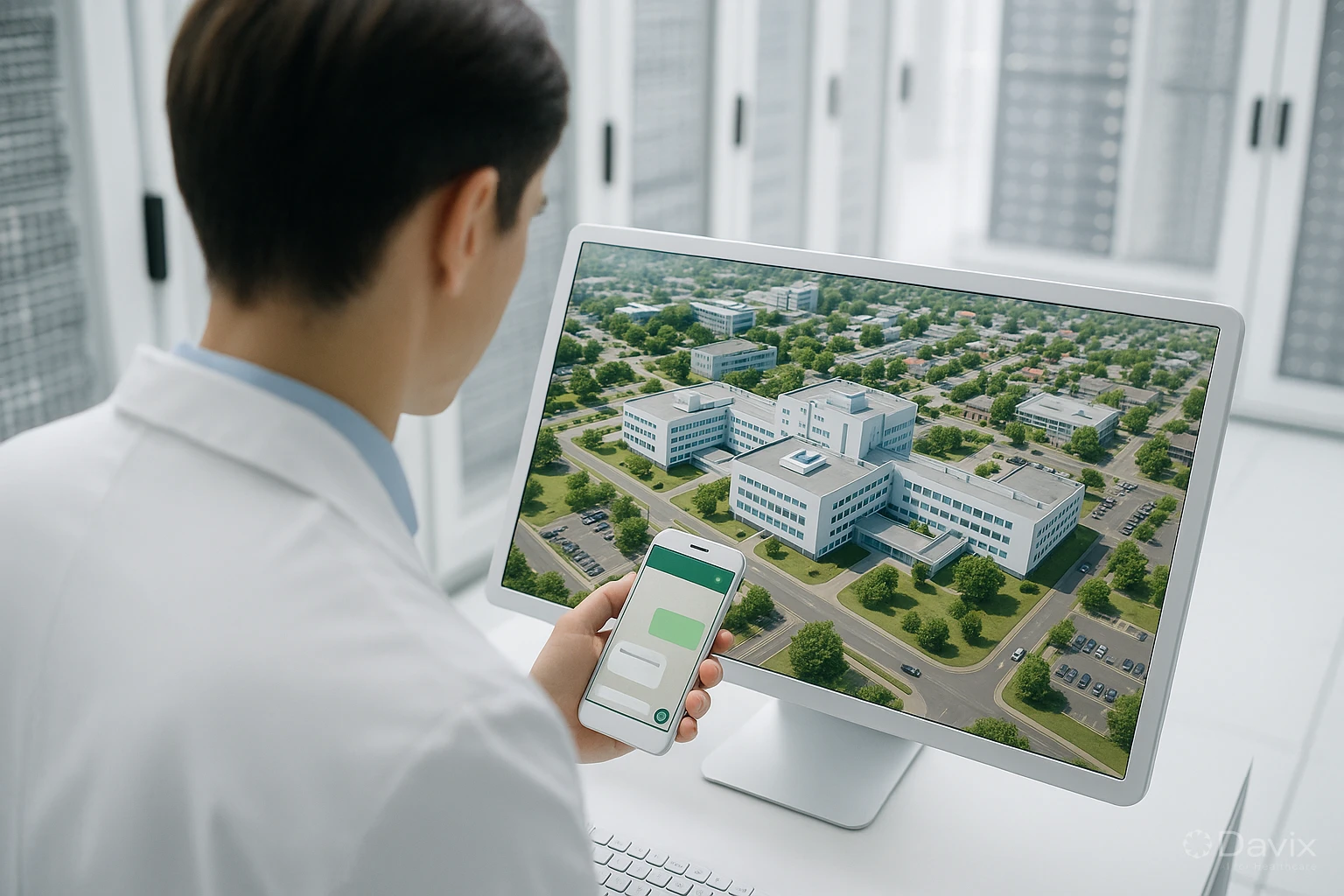
WhatsApp as a Healthcare Channel: Why LATAM Leads This Revolution
In Latin America, WhatsApp is the most used app: over 90% of smartphone users have it installed. It's not just a personal messaging app — it's become the way people expect to communicate with any service, including their clinic, laboratory, or imaging center.
While the rest of the world debates between web portals, proprietary apps, and SMS, LATAM has already solved the problem: the channel is WhatsApp. The question isn't whether to use it, but how to use it professionally, securely, and in an automated way.
Why WhatsApp works better than any other channel in healthcare
Unbeatable open rate
| Channel | Open rate | Average read time |
|---|---|---|
| 20–25% | 6 hours | |
| SMS | 85–90% | 3 minutes |
| 95–98% | 90 seconds | |
| Proprietary app | 15–30% (if downloaded) | Variable |
| Phone call | 40–60% (answer rate) | Immediate but invasive |
WhatsApp wins on every front: almost everyone reads it, they read it fast, and it doesn't require the patient to install anything new.
It's already the channel your patients use
Your patients already use WhatsApp to communicate with you, but probably in a disorganized way:
- They text the doctor's or receptionist's personal number
- They send photos of prescriptions or results via chat
- They ask about schedules, prices, and availability at any hour
- They don't get responses on weekends
This creates an inconsistent experience and puts patient privacy at risk (clinical data circulating on personal WhatsApp).
5 professional uses of WhatsApp in healthcare
1. Automatic result notifications
When a lab result is validated or a radiology report is signed, the patient automatically receives a WhatsApp message with a secure link to view it.
Benefit: Eliminates 80% of patient calls asking "are my results ready?"
2. Appointment confirmation and reminders
The system automatically sends:
- Confirmation immediately when the patient schedules an appointment
- Reminder 24 hours before the appointment
- Follow-up after the visit (satisfaction survey, next appointment)
Benefit: Reduces no-shows by 25% to 40%.
3. Urgent study alerts
When a radiologist flags a finding as urgent, the referring physician receives an immediate WhatsApp notification.
Benefit: Reduces critical findings communication time from hours to minutes.
Ready to digitize your health center?
Discover how Davix can transform your hospital or clinic management with world-class technology.
Schedule Free Demo4. Pre-procedure instructions
Before a study requiring preparation (fasting, contrast, medication suspension), the patient receives instructions via WhatsApp.
Benefit: Reduces studies canceled due to poor patient preparation.
5. Billing and collections
Invoice delivery, payment reminders, and payment links via WhatsApp.
Benefit: Accelerates the collection cycle and reduces accounts receivable.
Personal WhatsApp vs WhatsApp Business API: the critical difference
Using personal WhatsApp is not the same as the official WhatsApp Business API:
| Aspect | Personal WhatsApp | WhatsApp Business API |
|---|---|---|
| Automation | ❌ Manual | ✅ Fully automatable |
| Multiple agents | ❌ Single phone | ✅ Multiple simultaneous operators |
| System integration | ❌ No | ✅ Integrable with PACS, HIS, LIS |
| Approved templates | ❌ No | ✅ Messages pre-approved by Meta |
| Privacy compliance | ❌ Data on personal phone | ✅ Data on secure platform |
| Scalability | ❌ Limited | ✅ Thousands of messages/day |
| Reports and metrics | ❌ No | ✅ Delivery and read dashboard |
If your clinic uses personal WhatsApp to communicate with patients, you're assuming privacy risks and missing the opportunity to automate.
How Davix integrates WhatsApp into the clinical workflow
Davix WhatsApp isn't a separate messaging tool — it's a native integration that works within the existing clinical workflow.
- PACS/RIS integration: When the radiologist signs a report, the patient receives the notification automatically.
- LIS integration: When lab results are validated, the patient receives a link to their portal.
- HIS integration: Appointment reminders, confirmations, and follow-ups are sent automatically.
- Billing integration: Invoices and payment reminders are sent via WhatsApp.
There's nothing to configure manually. Notifications are sent as part of the normal workflow, without your team having to open WhatsApp, search for contacts, or type messages.
Legal framework: is it legal to send health data via WhatsApp?
Legality depends on how you do it:
- Personal WhatsApp: Sending clinical data via personal WhatsApp is bad practice that may violate data protection regulations. Data remains on the employee's phone, without enterprise encryption or access control.
- WhatsApp Business API + secure platform: When messages are sent from an integrated platform (like Davix), clinical data isn't sent in the message. A secure link is sent that takes the patient to a protected portal where they authenticate and view their results. The WhatsApp message only says "your results are ready" with a link — it contains no clinical data.
This is the correct and legal way to use WhatsApp in healthcare.
Frequently asked questions
Does WhatsApp replace the patient portal?
No, it complements it. WhatsApp is the notification channel (it alerts that results are ready). The patient portal is where the patient views results securely. Both work together: WhatsApp notifies, the portal displays.
How much does WhatsApp integration with Davix cost?
WhatsApp integration is available from the Enterprise plan of each product, and also as a standalone module from $15 USD/mo. There's no per-message cost within approved transactional templates.
Can patients reply to WhatsApp messages?
It depends on the configuration. You can enable a chatbot flow for frequently asked questions (hours, location, prices) or redirect replies to your patient care team. Replies are managed from the platform, not from a personal phone.
What if the patient doesn't have WhatsApp?
For the small percentage of patients without WhatsApp, results remain available on the web portal and can be notified via email or SMS as an alternative channel.
Conclusion
WhatsApp isn't the future of healthcare communication in LATAM. It's the present. Key takeaways:
- 95-98% open rate — No other channel comes close.
- The patient already uses it — No need to download another app.
- Must be used professionally — WhatsApp Business API, not personal WhatsApp.
- Don't send clinical data via WhatsApp — Send notifications with secure portal links.
- Integrate it into your clinical workflow — Notifications should be automatic, not manual.
Check Davix WhatsApp pricing or schedule a demo to see how it works integrated with your clinical operation.
Related articles
How to Automate Appointment Scheduling at Your Clinic and Reduce Administrative Burden (2026)
Practical guide to automating medical appointment scheduling: reduce phone calls, eliminate double booking, and improve patient experience with digital tools.
How to Migrate Your PACS to the Cloud Without Losing Studies: A Step-by-Step Guide (2026)
Complete guide to migrating from an on-premise PACS to the cloud: planning, DICOM data migration, validation, and best practices to not lose a single study.

Set Up Teleradiology with Davix in 15 Minutes: Step-by-Step Tutorial
Practical tutorial to configure teleradiology with Davix PACS/RIS: from creating users to receiving the first signed report, in under 15 minutes.
