

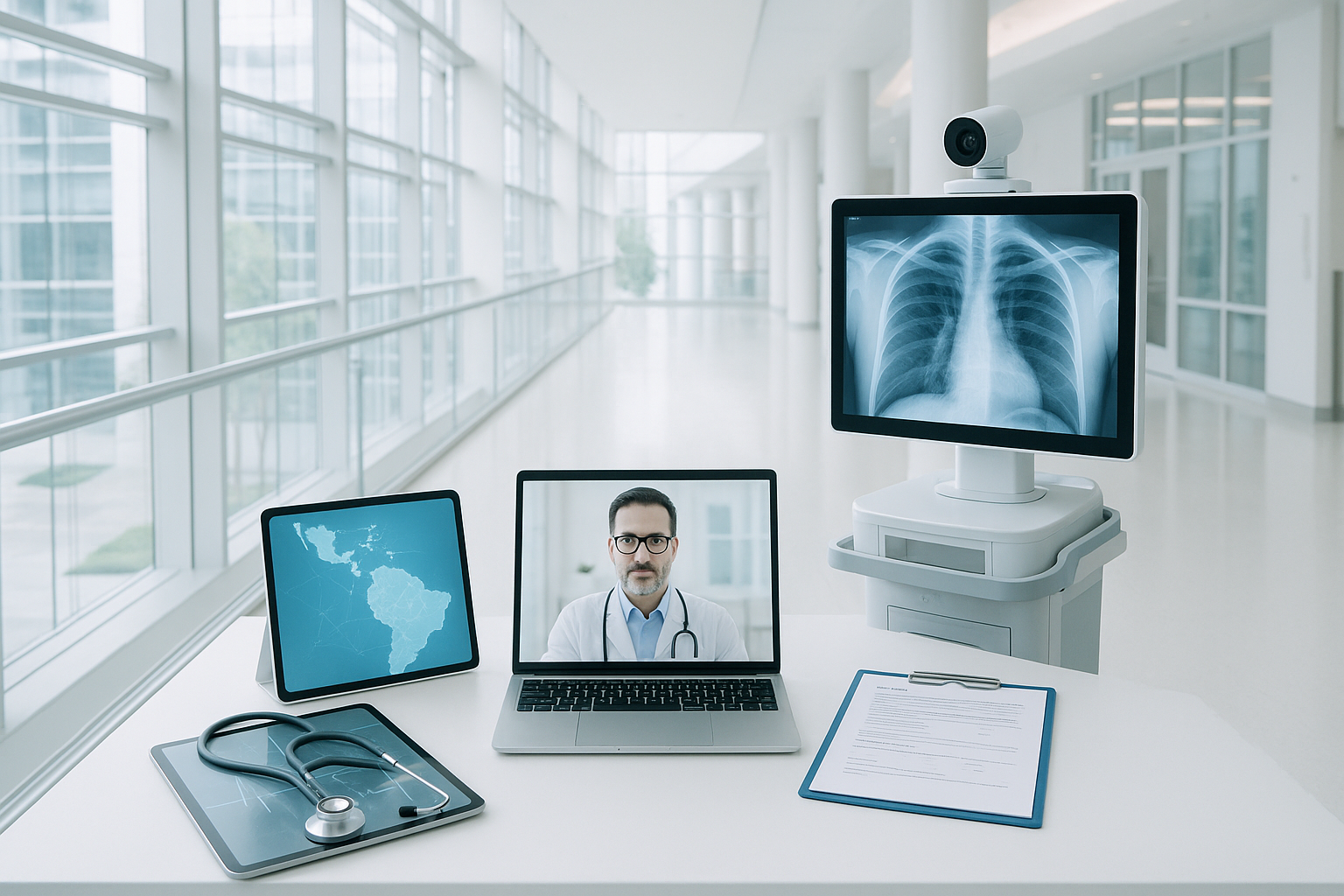
Telemedicine in LATAM: The Before and After That Transformed the Region
If someone had said in 2019 that in less than two years telemedicine would go from being an experimental niche to becoming a pillar of Latin American health systems, few would have believed it. The FIME report from that year described telemedicine as an "emerging" technology — Mexico was using it to "increase reach to patients" in remote areas, but widespread adoption was more of a wish than a reality.
In 2026, the picture is completely different. This article analyzes the before and after of telemedicine in LATAM, the regulatory evolution by country, and why teleradiology has established itself as the most mature use case in the region.
The State in 2019: Experimental and Fragmented
Before the pandemic, telemedicine in Latin America existed in isolated pockets:
- Brazil had specific telessaúde experiences through the Telessaúde Brasil Redes program, connecting specialists with basic health units in remote areas of the north and northeast.
- Colombia experimented with teleconsultation in rural areas through university-hospital partnerships, but without a specific regulatory framework.
- Mexico led in the private sector with teleconsultation startups, while the public sector used it primarily to reach indigenous and rural communities.
- Chile was piloting the Hospital Digital program since 2018, with promising results but limited reach.
- Peru had the National Telehealth Plan but with incipient implementation, concentrated in Lima and a few departmental capitals.
The common denominator was clear: telemedicine was a marginal complement, not a primary care channel. Doctors distrusted its clinical validity, patients were unaware of it, and regulatory frameworks were nonexistent or ambiguous.
Pre-Pandemic Barriers
The FIME 2019 report identified obstacles that seemed structural:
- Insufficient connectivity: less than 50% of the rural Latin American population had access to broadband internet.
- Absence of regulation: most countries had no laws that legally validated a virtual consultation or remote diagnosis.
- Cultural resistance: both doctors and patients preferred in-person consultations. The doctor-patient relationship was understood as inherently face-to-face.
- Lack of technological infrastructure: public hospitals lacked the platforms, equipment, and bandwidth to offer telemedicine services.
The Catalyst: COVID-19 (2020-2021)
The pandemic left no choice. When lockdowns closed offices and hospitals became overwhelmed with COVID patients, telemedicine went from luxury to necessity in a matter of weeks.
Adoption grew by more than 300% according to the Inter-American Development Bank. But the most significant development was not the volume — it was the speed at which regulatory frameworks adapted:
- Colombia: Resolution 521 of 2020 from the Ministry of Health formally enabled telemedicine during the health emergency, establishing technical guidelines for non-in-person health service delivery.
- Peru: Emergency Decree 058-2020 and the subsequent Ministerial Resolution regulated telemedicine and electronic prescriptions, enabling formal remote care.
- Chile: the capabilities of the Hospital Digital program were expanded and electronic medical leave was enabled.
- Brazil: Law 13,989 of April 2020 authorized the use of telemedicine during the crisis, and in 2022 CFM Resolution 2,314 regulated it permanently.
- Mexico: Official Mexican Standard NOM-024-SSA3-2012 already existed but was supplemented with specific guidelines for teleconsultation during the pandemic.
What previously would have taken years of legislative debate happened in months. The pandemic compressed a decade of regulatory evolution into a single year.
Ready to digitize your health center?
Discover how Davix can transform your hospital or clinic management with world-class technology.
Schedule Free DemoRegulatory Evolution by Country: From Emergency to Permanence
Peru
Peru moved from emergency regulation to a permanent framework. Telemedicine regulation in Peru today allows teleconsultation, telemonitoring, and teleinterconsultation as formal modalities. The National Registry of Electronic Health Records (RENHICE) has been strengthened to support documentation of remote care. However, connectivity in the highlands and jungle remains the greatest challenge — more than 40% of rural communities lack stable internet.
Colombia
Colombia has made significant advances in telemedicine with Resolution 3100 of 2019 (updated post-pandemic), which establishes accreditation conditions for telehealth services. Universities have been engines of innovation, with telepathology, teledermatology, and teleradiology programs connecting specialists in Bogota and Medellin with hospitals in Choco, Amazonas, and Guainia. Law 2015 of 2020 on Interoperable Electronic Health Records has been key to enabling telemedicine to function with continuity of care.
Chile
The Hospital Digital program has become a regional benchmark. With more than 4 million remote consultations conducted since its creation, Chile demonstrates that telemedicine works at scale in a public health system. Chilean regulation has evolved to cover not only teleconsultation but also telerehabilitation, telemental health, and telemonitoring of chronic patients.
Brazil
Brazil, as the largest health market in LATAM, has consolidated telemedicine as a permanent care channel. CFM Resolution 2,314 of 2022 from the Federal Council of Medicine established clear rules for teleconsultation, telemonitoring, teletriage, assisted telesurgery, and telediagnosis. The ConecteSUS program, which reaches more than 150 million Brazilians, integrates telemedicine data with the national digital health record.
Mexico
Telemedicine in Mexico has a dual development: the private sector innovates rapidly with teleconsultation platforms serving millions of consultations annually, while the public sector advances more slowly. COFEPRIS has begun regulating medical software and telemedicine platforms, but the regulatory framework is still under construction to cover all modalities of remote care.
Teleradiology: The Most Mature Use Case
Of all telemedicine modalities, teleradiology has established itself as the most mature and proven in LATAM. The reasons are clear:
- Does not require synchronous interaction: unlike a teleconsultation, a radiological study can be sent, interpreted, and reported asynchronously, reducing dependence on real-time connectivity.
- High clinical impact: a timely radiological diagnosis can change the course of a patient's treatment. Teleradiology enables a rural hospital to access the same level of specialization as an urban one.
- Radiologist shortage: LATAM has an uneven distribution of radiologists — concentrated in capitals, scarce in provinces. Teleradiology virtually redistributes that capacity.
- Mature technology: PACS (Picture Archiving and Communication System) systems enable the transmission, storage, and visualization of medical images with diagnostic quality over the internet.
For a deeper dive into implementing teleradiology in the region, we recommend our article on teleradiology in Latin America: how to implement it.
Davix and Teleradiology
Davix integrates PACS and RIS with native teleradiology capabilities, enabling institutions of any size to:
- Receive studies from multiple modalities (CT, MRI, X-ray, ultrasound) on a centralized cloud platform.
- Assign studies to remote radiologists with automated workflows.
- Generate radiological reports with AI assistance and automatic distribution to the treating physician.
- Maintain complete traceability of the process, from image acquisition to report delivery.
Additionally, Davix's Plataforma Medico enables teleconsultation between specialists and between doctor and patient, covering the full spectrum of telemedicine.
Persistent Challenges
Despite exponential progress, telemedicine in LATAM faces structural challenges that cannot be solved by technology alone:
Rural Connectivity
The connectivity deficit in rural areas remains the most critical obstacle. A state-of-the-art teleconsultation platform is useless if the patient has no internet access. Rural connectivity projects like Internet para Todos in Peru and Brazil's fiber optic program are advancing, but universal coverage is far from being achieved.
Physician Resistance
Although the pandemic broke many barriers, a segment of healthcare professionals still considers in-person consultation irreplaceable for certain specialties. Evidence shows that telemedicine does not replace in-person consultation — it complements it. But achieving that cultural shift requires continuous training and demonstration of clinical results.
Financial Sustainability
During the pandemic, many telemedicine services were funded with emergency funds. The question now is how to make them sustainable. Pay-per-teleconsultation models, integration with health insurance, and the operational efficiency they generate are part of the answer.
Quality and Standards
Not all telemedicine is equal. Without clear quality standards, there is a risk of teleconsultation services proliferating that do not meet minimum clinical requirements. Regulation must evolve not only to allow telemedicine but to guarantee its quality.
Conclusion: A Path of No Return
Telemedicine in Latin America has crossed a point of no return. Going back to the pre-pandemic state where virtual consultation was a curiosity is no longer possible. Patients who discovered the convenience of teleconsultation do not want to lose it. Doctors who experienced the efficiency of teleradiology do not want to rely exclusively on in-person practice. And governments that invested in digital infrastructure cannot undo that path.
What remains is consolidation. Improving connectivity, strengthening regulation, training healthcare personnel, and ensuring that telemedicine is not an urban privilege but an accessible right for the entire Latin American population. The tools exist — now the challenge is implementation at scale.
Related articles

From Chatbots to Intelligent Agents: How Davix Growth Is Transforming Healthcare Sales
From the FIME 2019 prediction about healthcare chatbots to the intelligent agents of 2026. How Davix Growth revolutionizes healthcare sales with autonomous, multilingual, and specialized AI.

Why Generic ERPs Fail in Hospitals (and What to Use Instead)
Comparative analysis of generic ERPs like SAP, Oracle, and Odoo versus specialized healthcare platforms. Discover why clinical workflows demand software designed for hospitals and clinics.

3 healthcare and radiology events you can't miss in 2026
Guide to the 3 most important healthcare and radiology congresses and expos for Latin American professionals in 2026: JPR São Paulo, ICR Cartagena, and WHX Miami. Dates, links, and why you should attend.