

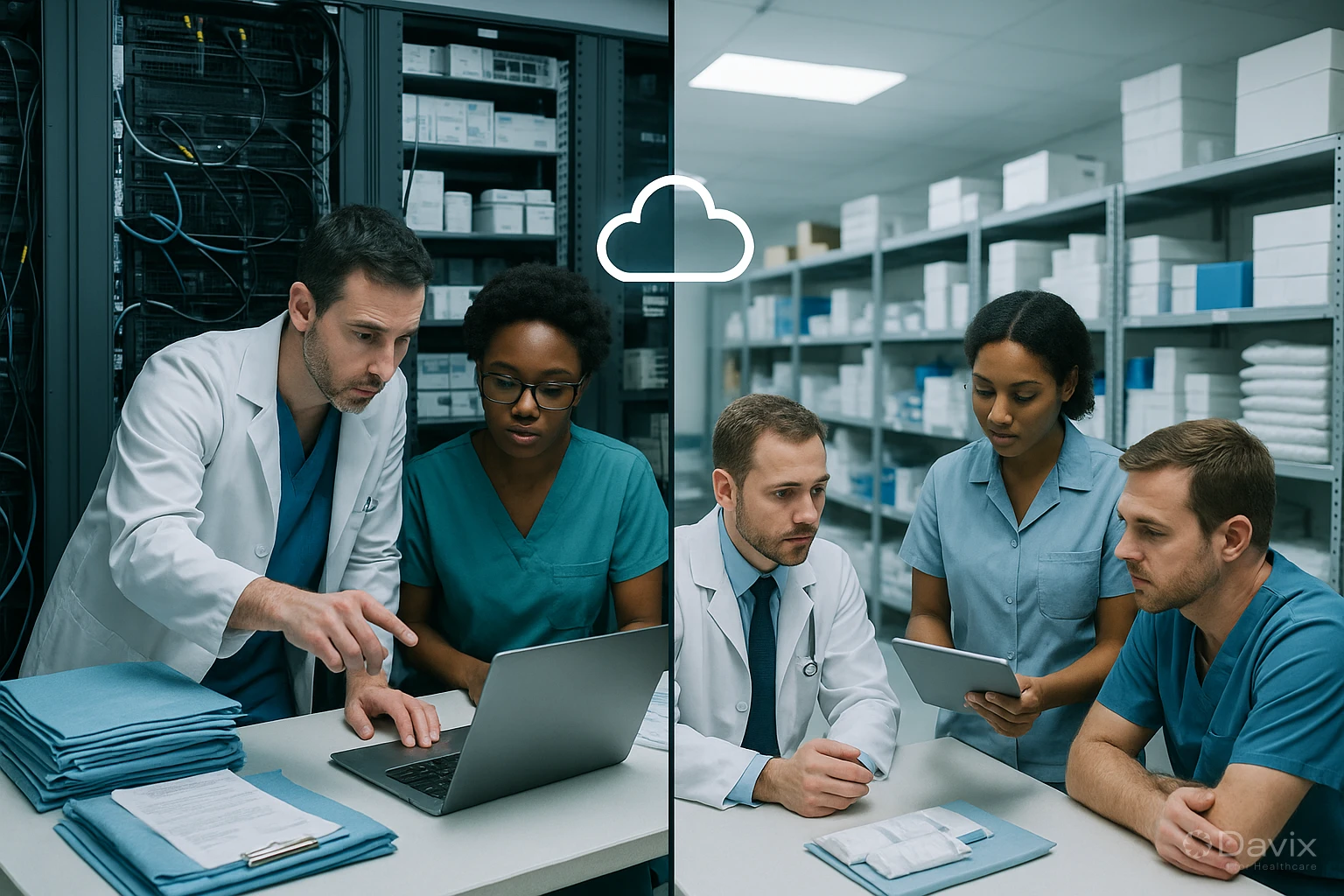
SaaS in Healthcare: How to Reduce IT Costs and Multiply Your Return on Investment
When a clinic or healthcare center evaluates investing in technology, the first question is usually: "How much does it cost?" But the right question is: "How much is it costing me NOT to invest?" The SaaS (Software as a Service) model has transformed the economics of healthcare technology, enabling institutions of any size to access world-class platforms without the financial and operational burden of maintaining their own infrastructure. In this article, we break down the numbers.
The Traditional Model: On-Premise Servers
In the traditional model, a clinic that wants to implement an information system must:
- Purchase physical servers with enough capacity for current and future data volumes.
- Acquire perpetual software licenses, typically with a high upfront payment.
- Hire IT staff to install, configure, maintain, and update the system.
- Prepare a physical space with climate control, UPS (backup power), and security to house the servers.
- Implement backups and disaster recovery plans.
- Pay annual maintenance for hardware and software (typically 15-20% of the license cost).
Typical On-Premise Cost Breakdown (5 Years)
| Item | Estimated Cost |
|---|---|
| Servers and hardware | $25,000 - $80,000 |
| Software licenses | $30,000 - $100,000 |
| IT staff (partial) | $60,000 - $150,000 |
| Physical infrastructure (space, UPS, climate control) | $10,000 - $30,000 |
| Maintenance and updates | $20,000 - $50,000 |
| Backup and recovery | $5,000 - $15,000 |
| Total over 5 years | $150,000 - $425,000 |
On top of this, you must factor in hidden costs: downtime from hardware failures, updates that don't happen due to budget constraints, security vulnerabilities that go unpatched, and technological obsolescence that forces hardware replacement every 3-5 years.
The SaaS Model: Pay for What You Use
In the SaaS model, the clinic pays a monthly or annual subscription that includes:
- Full access to the software and all its features.
- Cloud hosting with guaranteed availability (99.9%+).
- Automatic and continuous updates at no additional cost.
- Automatic backup and disaster recovery.
- Technical support included.
- Scalability as the institution grows.
Typical SaaS Cost Breakdown (5 Years)
| Item | Estimated Cost |
|---|---|
| Monthly subscription (all-inclusive) | $50,000 - $120,000 |
| Initial implementation and setup | $5,000 - $15,000 |
| Dedicated IT staff | $0 (not required) |
| Additional hardware | $0 |
| Maintenance | $0 (included) |
| Total over 5 years | $55,000 - $135,000 |
The difference is striking: the SaaS model can deliver savings of 50% to 70% in Total Cost of Ownership (TCO) over 5 years.
Ready to digitize your health center?
Discover how Davix can transform your hospital or clinic management with world-class technology.
Schedule Free DemoBeyond Savings: Strategic Advantages of SaaS
Rapid Implementation
An on-premise system can take 3 to 12 months to become operational, between hardware procurement, installation, configuration, and training. A SaaS solution can be up and running in 2 to 6 weeks, because the infrastructure is already ready in the cloud.
Continuous Updates
With on-premise, updates are projects that require planning, testing, and maintenance windows. Many clinics end up running outdated versions of their software because upgrading is too complex or costly.
With SaaS, updates are deployed automatically and transparently. Your clinic always operates on the latest version, with the latest features and the latest security patches.
Frictionless Scalability
If your clinic grows — opens a new location, adds more specialties, or increases patient volume — an on-premise system requires purchasing more servers, more licenses, and more storage capacity. With SaaS, you simply adjust your subscription and the platform scales automatically.
Enterprise-Grade Security
Specialized healthcare SaaS providers invest millions in security: data encryption in transit and at rest, SOC 2 certifications, HIPAA compliance, 24/7 monitoring, and dedicated cybersecurity teams. An individual clinic would find it nearly impossible to achieve this level of protection with its own resources.
Business Continuity
A local server failure can leave your clinic without a system for hours or days. A SaaS solution operates with geographic redundancy: if one datacenter experiences issues, traffic is automatically redirected to another. Downtime is virtually zero.
How to Calculate Your ROI
To evaluate the return on investment of migrating to SaaS, consider these factors:
Recovered Revenue
- Reduced no-shows (automated reminders): if your clinic loses 10 appointments per day at an average of $30 each, that's $9,000/month in lost revenue. Reducing no-shows by 30% recovers $2,700/month.
- Eliminated billing leakage (unrecorded charges): clinics typically lose between 3% and 5% of revenue from services rendered but never billed. An integrated system closes these gaps.
Eliminated Costs
- IT staff: Reduction or elimination of staff dedicated to maintaining servers.
- Printing supplies: Elimination of printed results, reports, and clinical documents.
- Physical space: Freeing up square footage dedicated to servers and archives.
Operational Efficiency
- More patients seen by the same staff, thanks to automation.
- Fewer overtime hours for administrative personnel.
- Faster decisions with real-time dashboards.
Clinics that migrate to a SaaS model report a positive ROI within an average of 3 to 6 months from implementation.
"What If the SaaS Provider Disappears?"
This is a legitimate concern. The key is to choose a provider with:
- Proven track record in the healthcare sector.
- Clear contracts with data portability clauses.
- Open standards (DICOM, HL7, FHIR) that allow data migration to another platform if needed.
- Exportable backups that the clinic can download periodically.
Conclusion
The SaaS model is not a technology trend: it is the natural evolution of how healthcare institutions should consume technology. It reduces TCO by 50% to 70%, eliminates the operational burden of maintaining infrastructure, guarantees continuous updates, and scales with your institution's growth.
At Davix, we operate under a 100% SaaS model designed for the Latin American healthcare sector. No upfront hardware investment, no hidden costs, rapid implementation, and dedicated support. If your clinic still maintains its own servers, the numbers speak for themselves: it's time to migrate to the cloud.
Related articles

From Chatbots to Intelligent Agents: How Davix Growth Is Transforming Healthcare Sales
From the FIME 2019 prediction about healthcare chatbots to the intelligent agents of 2026. How Davix Growth revolutionizes healthcare sales with autonomous, multilingual, and specialized AI.

Why Generic ERPs Fail in Hospitals (and What to Use Instead)
Comparative analysis of generic ERPs like SAP, Oracle, and Odoo versus specialized healthcare platforms. Discover why clinical workflows demand software designed for hospitals and clinics.

3 healthcare and radiology events you can't miss in 2026
Guide to the 3 most important healthcare and radiology congresses and expos for Latin American professionals in 2026: JPR São Paulo, ICR Cartagena, and WHX Miami. Dates, links, and why you should attend.