

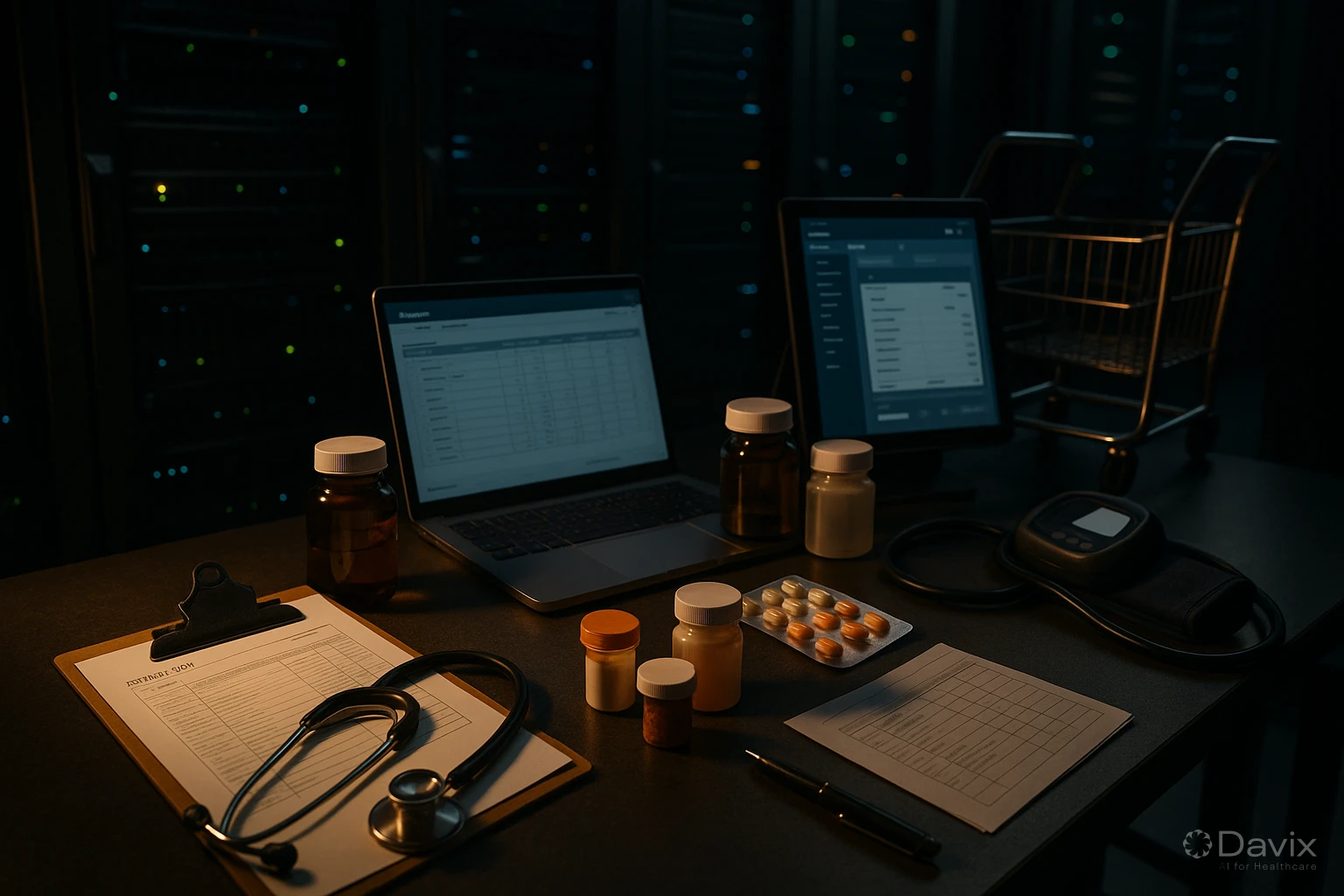
Hospital Logistics: How to Manage Inventory, Pharmacy, and Procurement Without Losing Money
Hospital logistics is the invisible area that can make or break a clinic's profitability. A medication that's unavailable when needed, a supply expiring in the warehouse, a duplicate purchase — every logistics error has a direct cost that's rarely quantified.
In Latin America, where operating margins for clinics and hospitals are tight, optimizing the supply chain is not a luxury — it's survival.
The 3 pillars of hospital logistics
1. Inventory control
Healthcare inventory is particularly complex because it involves:
- Medications with expiration dates and cold chain requirements
- Medical supplies with strict technical specifications
- Office and cleaning materials with regular consumption
- Equipment and spare parts of high value
Common problems without a system:
- Phantom inventory (system says it's there, but it's not)
- Over-stock leading to expirations
- Emergency purchases at premium prices
- Uncontrolled loss and shrinkage
2. Pharmacy management
Hospital pharmacy has specific regulations that differentiate it from a generic warehouse:
- Traceability of lot and expiration is mandatory
- Controlled substance management (psychotropics, narcotics)
- Dispensing linked to medical prescriptions
- Drug interaction alerts
3. Procurement process
An efficient procurement process ensures supplies arrive on time, at the best price, and in the right quantity.
| Process | Manual | Digitized |
|---|---|---|
| Purchase request | Paper form → physical approval | Digital request → system approval |
| Quotation | Calls and emails | Automated comparison |
| Purchase order | Word/Excel document | PO integrated with inventory |
| Receiving | Manual counting | Scanning and automatic validation |
| Payment | Paper invoice → accounting | Integrated into accounting flow |
Ready to digitize your health center?
Discover how Davix can transform your hospital or clinic management with world-class technology.
Schedule Free DemoHow much logistics inefficiency costs
For a mid-sized hospital (100 beds):
| Concept | Estimated annual loss |
|---|---|
| Expired medications | $5,000–$15,000 USD |
| Emergency purchases (20-40% overprice) | $8,000–$20,000 USD |
| Uncontrolled shrinkage and loss | $3,000–$10,000 USD |
| Administrative time on manual processes | $6,000–$12,000 USD |
| Dispensing errors | Incalculable (clinical risk) |
| Estimated annual total | $22,000–$57,000 USD |
5 practices to optimize your logistics
1. Implement cycle counting
Instead of a full inventory once a year, count a different category each week. You detect problems before they grow.
2. Use minimum and maximum levels
Define minimum and maximum stock for each supply. The system generates automatic alerts when reorder points are reached.
3. Apply FEFO for medications
First Expired, First Out: always dispense what expires first, not what arrived first.
4. Centralize procurement
A procurement committee that consolidates requests, negotiates with suppliers, and prevents duplicate purchases.
5. Integrate inventory with the clinical system
When the physician prescribes, inventory updates. When nursing dispenses, it's recorded. No double data entry.
Frequently asked questions
Does a generic inventory system work for a hospital?
No. A hospital needs lot control, expiration tracking, controlled substances, and traceability that a generic system doesn't handle. A specialized HIS includes these features.
How long does it take to implement a hospital logistics system?
With an integrated system like Davix, 4-8 weeks for inventory and pharmacy modules. Includes catalog migration and training.
Can I start with just pharmacy and add inventory later?
Yes. Davix's modular approach allows phased implementation.
How does it integrate with accounting?
Purchase orders, receivings, and inventory movements are automatically reflected in the commercial management module.
Conclusion
Hospital logistics is where profitability is won or lost:
- Expired medications and emergency purchases cost a mid-sized hospital $22,000–$57,000 USD annually.
- Inventory control must be integrated with the clinical system, not in a spreadsheet.
- Hospital pharmacy requires specific features (lots, expirations, controlled substances).
- Procurement must be digitized to eliminate over-stock and stock-outs.
- Davix HIS includes inventory, pharmacy, and procurement modules natively integrated.
Check Davix pricing or schedule a demo to see how to optimize your hospital logistics.
Related articles

How to Automate Appointment Scheduling at Your Clinic and Reduce Administrative Burden (2026)
Practical guide to automating medical appointment scheduling: reduce phone calls, eliminate double booking, and improve patient experience with digital tools.

How to Migrate Your PACS to the Cloud Without Losing Studies: A Step-by-Step Guide (2026)
Complete guide to migrating from an on-premise PACS to the cloud: planning, DICOM data migration, validation, and best practices to not lose a single study.

Set Up Teleradiology with Davix in 15 Minutes: Step-by-Step Tutorial
Practical tutorial to configure teleradiology with Davix PACS/RIS: from creating users to receiving the first signed report, in under 15 minutes.
