

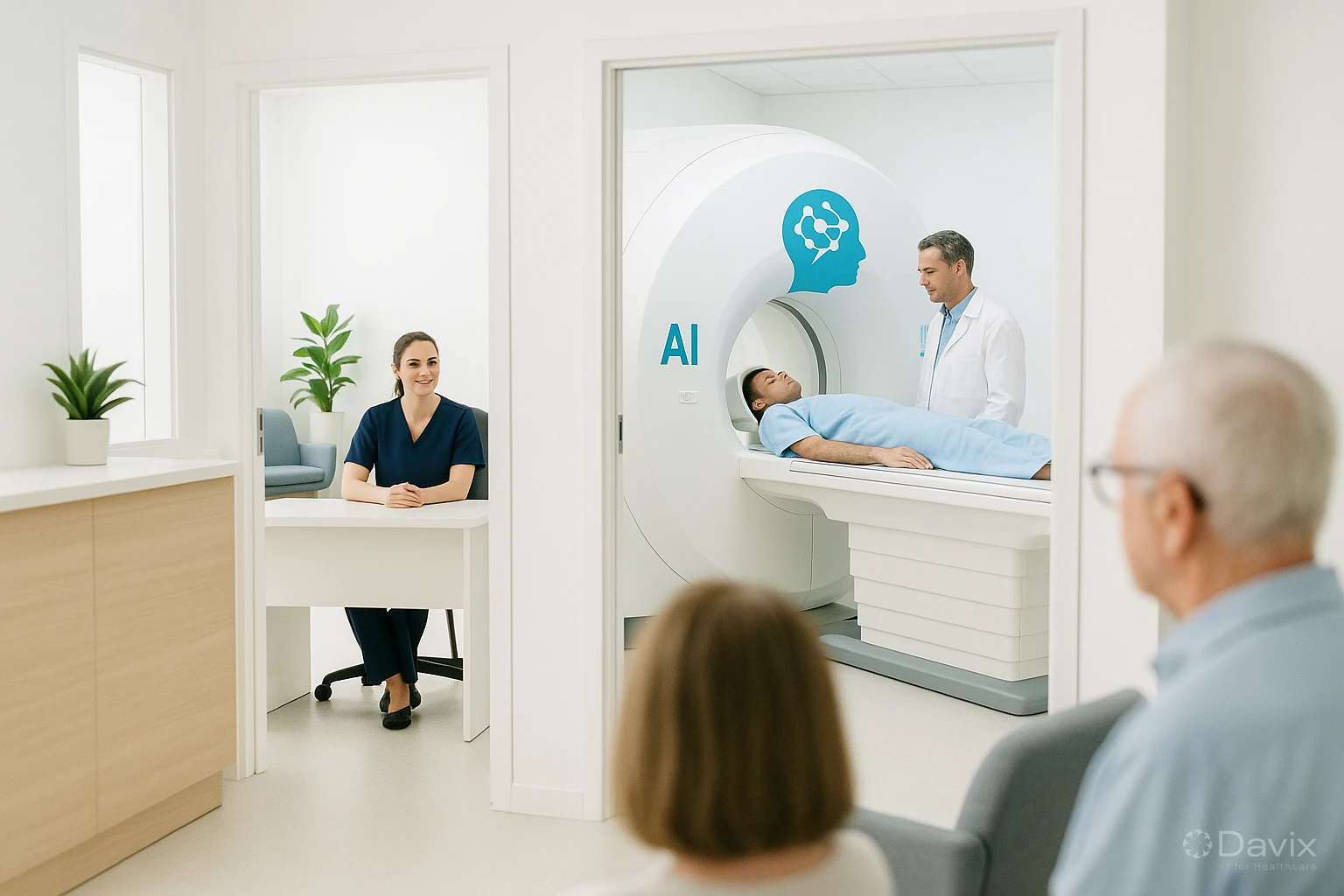
AI in Radiology: What Works Today and What's Just Marketing (2026)
Artificial intelligence in radiology generates attention-grabbing headlines: "AI will replace radiologists," "Automatic diagnosis with 99% accuracy," "The future of radiology is without radiologists." Reality is more nuanced, more useful, and less threatening.
This article separates what works today from what's just marketing, with a practical focus for imaging centers in Latin America.
What AI DOES do well today
1. Urgent finding detection (triage)
What it does: Analyzes images upon arrival at the PACS and automatically flags studies with findings requiring urgent attention (e.g., pneumothorax, intracranial hemorrhage, fractures).
Why it works: It doesn't diagnose — it prioritizes. It moves urgent studies to the top of the radiologist's worklist.
Real impact: Reduces critical finding detection time from hours to minutes. Especially valuable in teleradiology.
2. Automated quantification and measurement
What it does: Automatically measures anatomical structures: pulmonary nodule volume, cardiac ejection fraction, bone density, brain volume.
Why it works: Manual measurements are tedious and variable between observers. AI is consistent and fast.
Real impact: Saves radiologist time and reduces inter-observer variability.
3. Report pre-population
What it does: Generates a draft radiology report based on images, which the radiologist reviews, edits, and signs.
Why it works: The radiologist doesn't start from scratch. The draft covers routine findings and allows focus on abnormalities.
Real impact: Reduces dictation time by 30-50% for routine studies.
Ready to digitize your health center?
Discover how Davix can transform your hospital or clinic management with world-class technology.
Schedule Free Demo4. Image quality control
What it does: Evaluates technical image quality upon receipt: is it centered? Correct exposure? Motion artifacts?
Why it works: Detects quality issues before the radiologist wastes time reviewing a technically inadequate study.
Real impact: Reduces repeat studies and improves overall quality.
What AI does NOT do well (yet)
1. Autonomous diagnosis
No AI algorithm has regulatory approval to diagnose autonomously without radiologist supervision. For good reasons: AI has biases, limitations in atypical cases, and cannot integrate complete clinical context.
2. Replace the radiologist
The radiologist who uses AI will be more productive than one who doesn't. But AI without a radiologist is neither clinically nor legally viable.
3. Work equally across all populations
Algorithms trained predominantly on U.S. and European data may have biases when applied to Latin American populations with different disease prevalence.
How to evaluate an AI solution for radiology
| Criterion | Key question |
|---|---|
| Clinical evidence | Does it have studies published in peer-reviewed journals? |
| Regulatory approval | Does it have FDA, CE Mark, or approval from your local authority? |
| PACS integration | Does it integrate via DICOM or require a separate workflow? |
| Training data | Does it include Latin American population data? |
| Pricing model | Per study, per month, or per license? |
| Measurable impact | Can it demonstrate time reduction or detection improvement? |
| Workflow | Does it integrate into the radiologist's workflow or is it an extra step? |
The role of PACS in AI
AI doesn't work in isolation. It needs to integrate into the existing workflow through the PACS:
- Study arrives at PACS
- PACS sends study to AI engine
- AI processes and returns results
- Results display in the PACS viewer
- Radiologist uses AI results as support for their report
If the PACS doesn't support this integration, AI requires a separate workflow that few radiologists will adopt.
Frequently asked questions
Do I need AI for my imaging center?
Not necessarily. If your volume is low (under 50 studies/day) and you have available radiologists, AI may not justify its cost. For high volume or teleradiology, AI triage is valuable.
How much does AI in radiology cost?
Varies enormously: from $1-5 USD per study to $2,000-10,000 USD monthly per license. Evaluate ROI before buying.
Does AI work with any modality?
Most AI solutions focus on chest X-ray, brain CT, and mammography. For other modalities, options are more limited.
Does Davix include AI?
Davix PACS supports integration with third-party AI engines via DICOM. This allows choosing the algorithm that best fits your specialty without being tied to a specific AI vendor.
Conclusion
AI in radiology is real and useful, but it's not magic:
- Triage and prioritization of urgent studies — works today and saves time.
- Automated quantification — eliminates tedious manual measurements.
- Report pre-population — reduces dictation time by 30-50%.
- Does not replace the radiologist — makes them more productive.
- Requires a modern PACS that supports DICOM integration with AI engines.
Davix PACS supports AI integration. Check pricing or schedule a demo.
Related articles

How to Automate Appointment Scheduling at Your Clinic and Reduce Administrative Burden (2026)
Practical guide to automating medical appointment scheduling: reduce phone calls, eliminate double booking, and improve patient experience with digital tools.
How to Migrate Your PACS to the Cloud Without Losing Studies: A Step-by-Step Guide (2026)
Complete guide to migrating from an on-premise PACS to the cloud: planning, DICOM data migration, validation, and best practices to not lose a single study.

Set Up Teleradiology with Davix in 15 Minutes: Step-by-Step Tutorial
Practical tutorial to configure teleradiology with Davix PACS/RIS: from creating users to receiving the first signed report, in under 15 minutes.
